
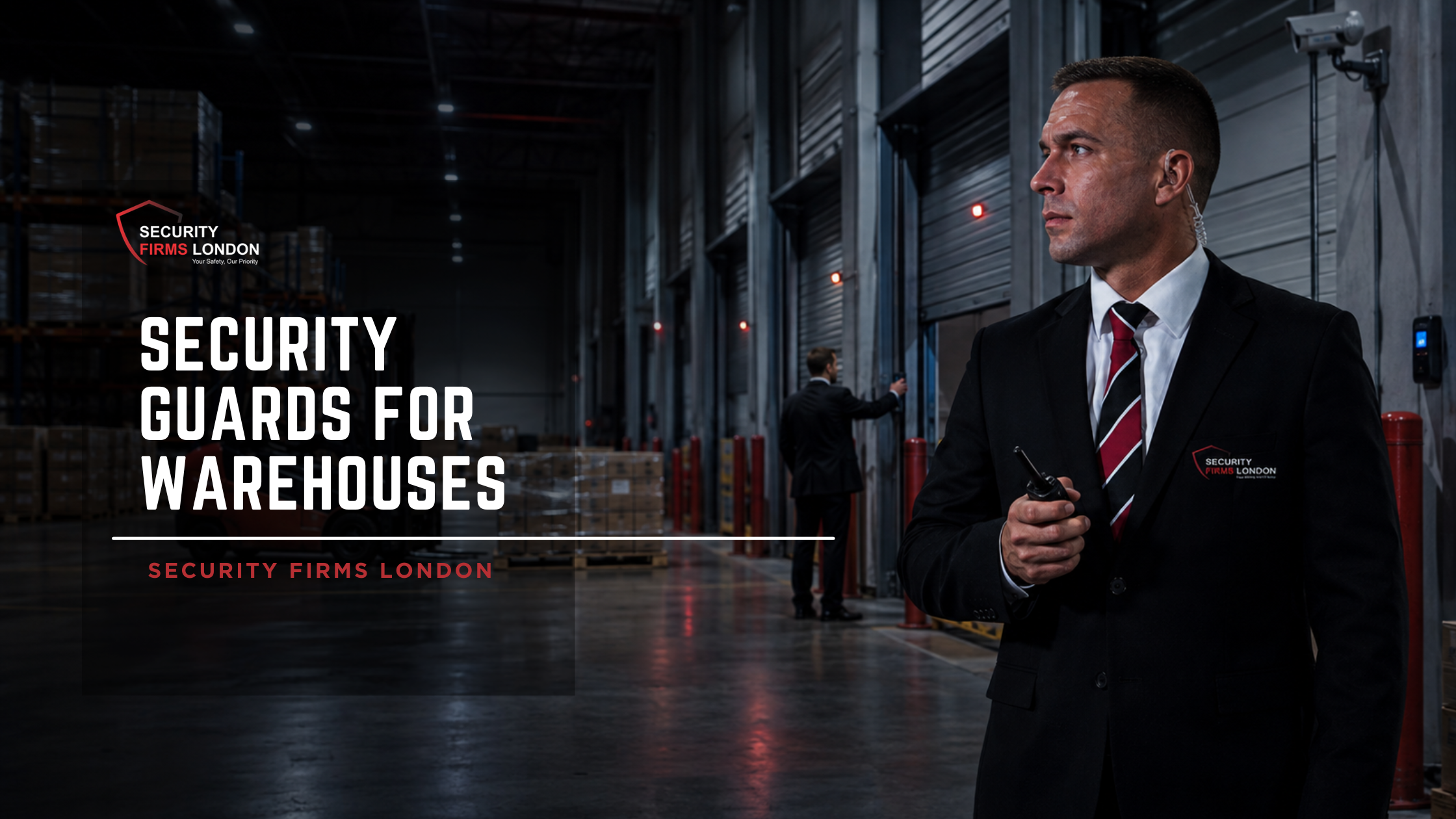
Security guards for warehouses protect stock, equipment, staff and vehicle movements at industrial and logistics sites. In London, this usually means SIA-licensed officers who control site access, patrol the perimeter, monitor CCTV and loading bays, log incidents, and respond to alarms out of hours. Good warehouse security is planned around the specific site, not bought off the shelf. The right cover depends on your layout, stock value, opening hours and delivery patterns. This guide explains what warehouse security involves, why it matters for London businesses, and how to choose officers who genuinely reduce risk.
Why Warehouse Security Matters for London Businesses
London warehouses, industrial units and distribution centres hold high-value, easily moved stock. That makes them a target, and their size makes them hard to watch. Many sites sit in quieter industrial areas across East, West and North London, where a break-in can go unnoticed for hours after closing.
The cost of a security failure is rarely just the stolen goods. A forced entry can damage doors, shutters and racking. Lost stock disrupts orders and delivery schedules. Staff feel uneasy returning to a site that was targeted. In short, weak security threatens both your assets and your day-to-day operations.
Professional warehouse security services in London reduce these risks in a practical way. Trained officers deter opportunists, control who comes on site, and act quickly when something goes wrong. Both visible guarding and proactive observation matter here: a uniformed presence puts people off, while an alert officer spots a problem before it grows.
What Security Guards for Warehouses Actually Do
Warehouse security is built around the site, not sold as a fixed package. In practice, the work that security guards for warehouses carry out covers a few core areas.
Access control at the gate
Officers manage who enters and leaves. They check drivers, contractors and visitors, log vehicle movements, and make sure only authorised people reach the loading bays. Firm access control procedures stop most casual theft and trespassing before it starts.
Perimeter patrols and internal checks
Warehouse security officers patrol the perimeter, fire exits, yard and racking on set and random routes. Mobile patrols suit sites that do not need a full-time presence, giving scheduled cover through the night for lower-risk or out-of-hours periods.
CCTV monitoring and alarm response
Cameras only help when someone watches them. Officers monitor CCTV, respond to alarms, and record what they see. Any monitoring should link to a clear, written response plan so nothing is missed.
Key holding and out-of-hours cover
With key holding, an officer holds your keys and attends alarm activations. Your staff no longer have to drive to an industrial estate alone at 3am, which is both safer and faster.
How Warehouse Security Differs From Other Sites
A warehouse is not a shop, an office or an event, so the security should not be identical either. Retail security guards deal with customers, shoplifting and the cash office on a busy floor. Corporate security leans on visitor management and access control in a staffed building. Construction site security focuses on machinery, materials and trespassers on an open, changing site.
A warehouse sits somewhere between these. It is often large, quiet and lightly staffed, with a steady flow of lorries and contractors. The pressure points are the gate, the loading bays and the long overnight hours. That is why distribution centre security relies so heavily on vehicle checks, controlled access and reliable patrols, rather than crowd management or a front-of-house welcome.
How to Set Up Warehouse Security: A Step-by-Step Process
Putting security guards for warehouses in place should follow a clear order, not a phone call and a badge the same afternoon.
- 1
Site risk assessment. Walk the site, then map entry points, stock value, blind spots, delivery patterns and quiet hours.
- 2
Written assignment instructions. Set out patrol routes, access rules, reporting lines and what to do in an incident.
- 3
Deploy SIA-licensed officers. Match officer numbers and hours to the actual risk, not a round figure.
- 4
Reporting and communication. Keep daily occurrence logs and incident reports, with a direct line to your site manager.
- 5
Review and adjust. Revisit the plan as stock, hours or threats change.
This is where a proper provider earns its place. Professional security is not only about presence. It is about risk assessment, prevention, communication, response, and consistent site supervision.
Common Mistakes London Warehouses Make
When buyers hire warehouse security guards in London, the same avoidable errors come up again and again.
- Buying on price alone. The cheapest quote often hides poor supervision and high staff turnover.
- Treating an SIA licence as the finish line. It is the legal minimum, not a quality guarantee.
- No site-specific instructions. Officers told only to “keep an eye out” miss things.
- Ignoring vetting. Ask whether officers are screened to British Standard BS 7858.
- No reporting. With no logs, you cannot prove an incident or improve your cover.
- Forgetting the loading bays. Much warehouse loss happens at goods-in and goods-out, not the front gate.
Expert Insight: Why the SIA Licence Is Only the Start
Every officer working on a UK site must hold a valid SIA licence. That much is law, set by the Security Industry Authority. But a licence only shows that an individual passed a basic check and training course. It says nothing about how that officer is supervised, briefed or supported once they are on your site.
The real difference shows in delivery. Look for a provider under the SIA Approved Contractor Scheme (ACS), the voluntary standard that audits how a company recruits, trains and manages its people. Then ask about vetting to BS 7858, how incidents are reported, and who supervises the officers day to day. Those are the marks of manned guarding you can actually rely on, and they are what separate steady industrial site security from a name on a badge.
Key Takeaways
- Security guards for warehouses protect stock, staff, vehicles and site access at industrial and logistics premises.
- Cover should follow a site-specific risk assessment, not a fixed off-the-shelf package.
- Core duties: access control, perimeter patrols, CCTV monitoring, alarm response and key holding.
- An SIA licence is the legal minimum; ACS status, BS 7858 vetting and real supervision mark out a strong provider.
- Clear reporting and communication keep warehouse security accountable and improving.
Summary
Warehouses in London face a particular mix of risks: high-value stock, large sites, quiet hours and constant vehicle movement. The right security guards for warehouses reduce theft, trespassing, vandalism and disruption through planned access control, patrols, monitoring and quick response. Strong warehouse security depends less on how many officers stand at the gate and more on how well they are briefed, vetted and supervised. If you run an industrial or distribution site and want cover built around your risks, Security Firms London can survey your site and recommend suitable, SIA-licensed protection.